FIXEDINTEL ACADEMY
A4 SUSPENSION & STEERING // REFERENCE

TIRE WEAR PATTERN LIBRARY

Seven classic tire wear patterns decoded. Each one points at a specific upstream system — inflation, alignment, suspension, or geometry. Replace tires without fixing the cause and the new tires wear out in 8,000 miles.

A4 STUDY HOME →
HOW TO READ THE PATTERNS

Inspect both fronts and both rears. The pattern + the location together get you the diagnosis fast. A single tire with a pattern points at one corner of the suspension. The same pattern on both tires of an axle points at inflation or alignment. The same pattern on all four often points at the customer's driving habits or a maintenance gap.

TIRE-RELATED

Inflation, balance, rotation interval, or driving style. Cheap fixes when caught early.

ALIGNMENT-RELATED

Camber, caster, toe, thrust angle. Set right and tires last; set wrong and they're gone fast.

SUSPENSION-RELATED

Worn struts, bushings, ball joints, tie-rods. Parts replacement first, then re-align.

SEVEN PATTERNS
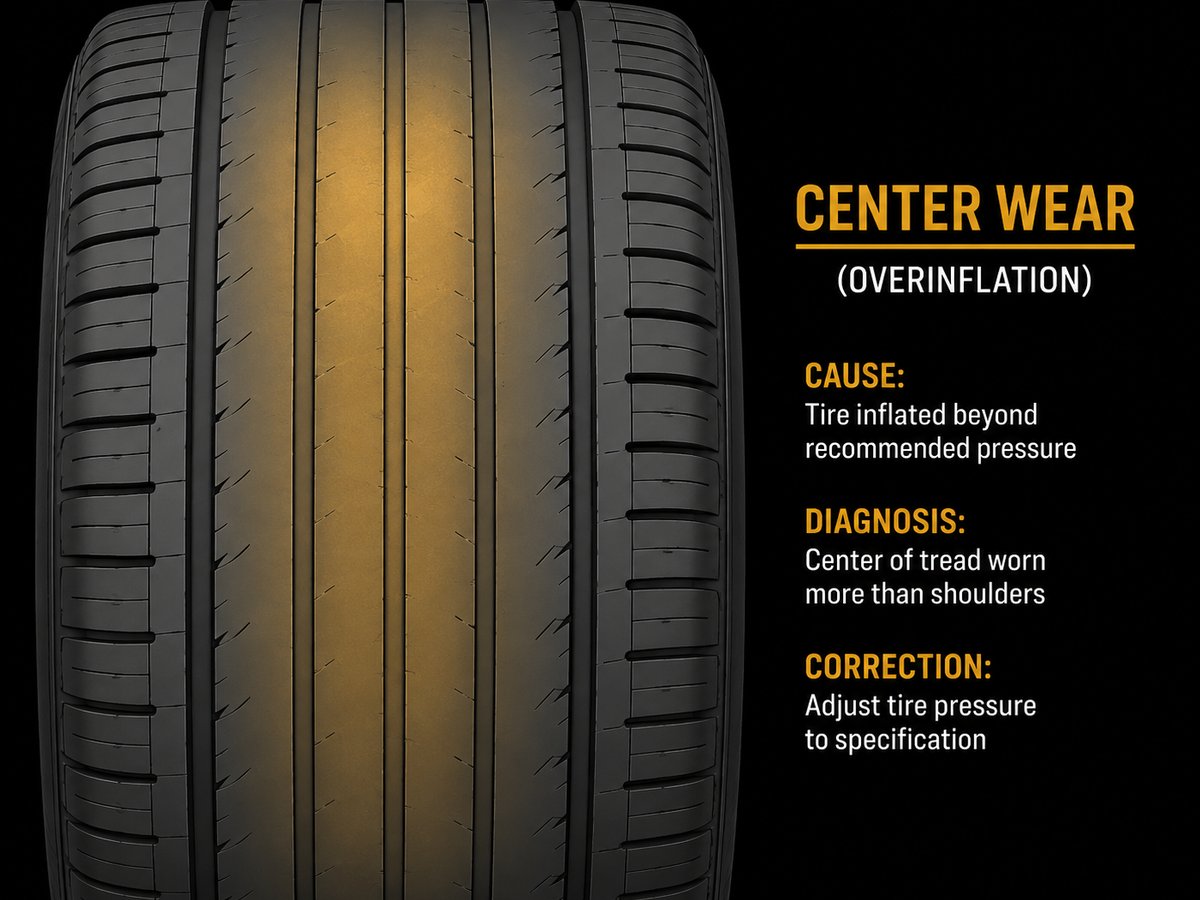
Tire showing center-tread wear

PATTERN 01 · CENTER WEAR

Tire

Center band worn, shoulders intact

VISUAL SIGNATURE

Center tread blocks worn smooth or significantly thinner than the outer shoulders. Tire profile looks rounded across the tread face. Wear is symmetric left-to-right.

ROOT CAUSE

Overinflation. Pressure too high stretches the carcass and lifts the shoulders off the road, putting all the load on the center contact patch. Common when owners read sidewall max pressure as recommended pressure (sidewall max ≠ door placard spec).

REPAIR SCOPE

Set to door placard spec at cold temperatures (typically 30–35 psi for passenger cars, 35–45 for light trucks). Educate customer on cold-pressure checking. Rotate tires; if center wear is severe, replacement is needed but always check TPMS calibration too.
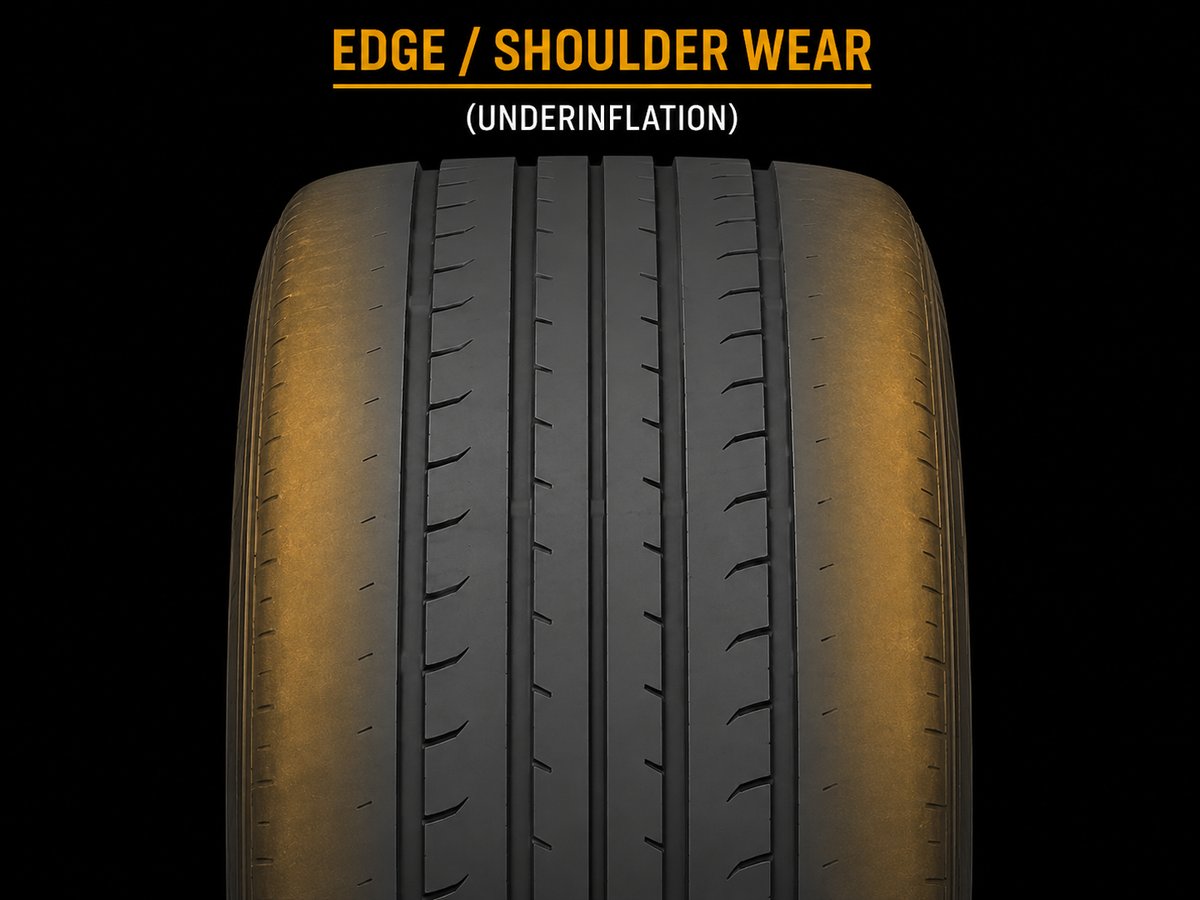
Tire showing both shoulders worn — underinflation pattern

PATTERN 02 · EDGE WEAR

Tire

Both shoulders worn, center intact

VISUAL SIGNATURE

Both outer edges (inside and outside shoulders) worn significantly more than the center tread. Tire profile looks dished or hollow in the middle. Same pattern on both sides of the same axle.

ROOT CAUSE

Underinflation. Pressure too low lets the carcass flex; the center lifts off the road and the shoulders take the load. Causes heat buildup (sidewall flex = friction) which accelerates wear and risks belt separation. Often paired with a slow leak the customer ignored.

REPAIR SCOPE

Find the leak source (valve stem, bead seal, sidewall puncture, slow porosity). Inspect for internal separation — heat-damaged tires can look intact externally but have broken belts. Replace TPMS sensors if older than 7 years (lithium batteries die). Customer education on monthly pressure checks.

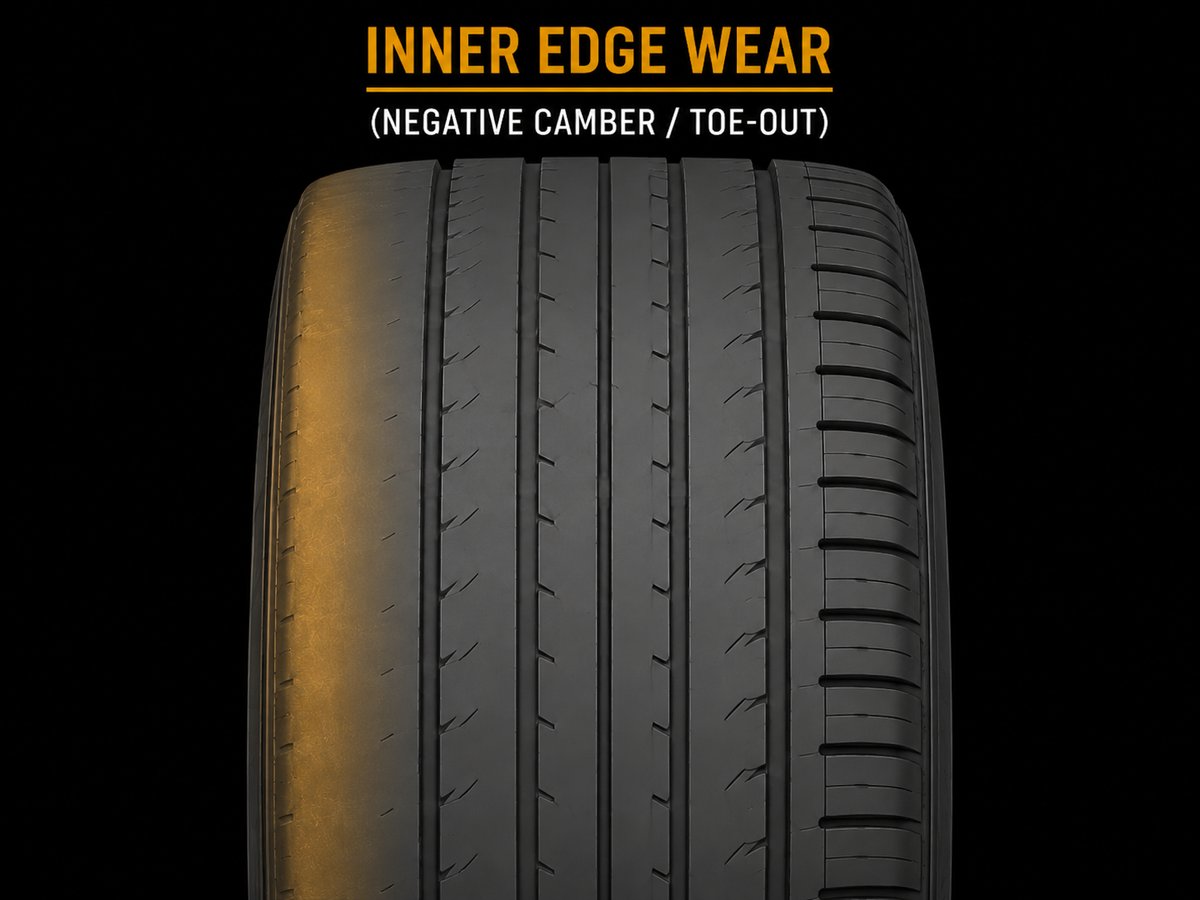
Tire showing inner edge wear

PATTERN 03 · INNER EDGE WEAR

Alignment

Inside edge gone, outside full

VISUAL SIGNATURE

Inboard edge (facing the vehicle) worn down to wear bars or cords. Outboard edge has nearly full tread depth. Asymmetric wear from inside to outside. Often shows on one tire of an axle, not both.

ROOT CAUSE

Excessive negative camber (top of wheel leaning in) or toe-out at that corner. Comes from worn ball joints, sagged spring, bent control arm, collision damage that wasn't measured, or simply an alignment that's drifted out of spec. Lowered vehicles run this pattern routinely without compensating camber kits.

REPAIR SCOPE

Full 4-wheel alignment with camber and SAI/IA measurements. If SAI is in spec but camber is out, you have a bent strut or knuckle that no adjustment will fix. Inspect ball joints, control arm bushings, and ride height before aligning. Replace worn parts first, then align.

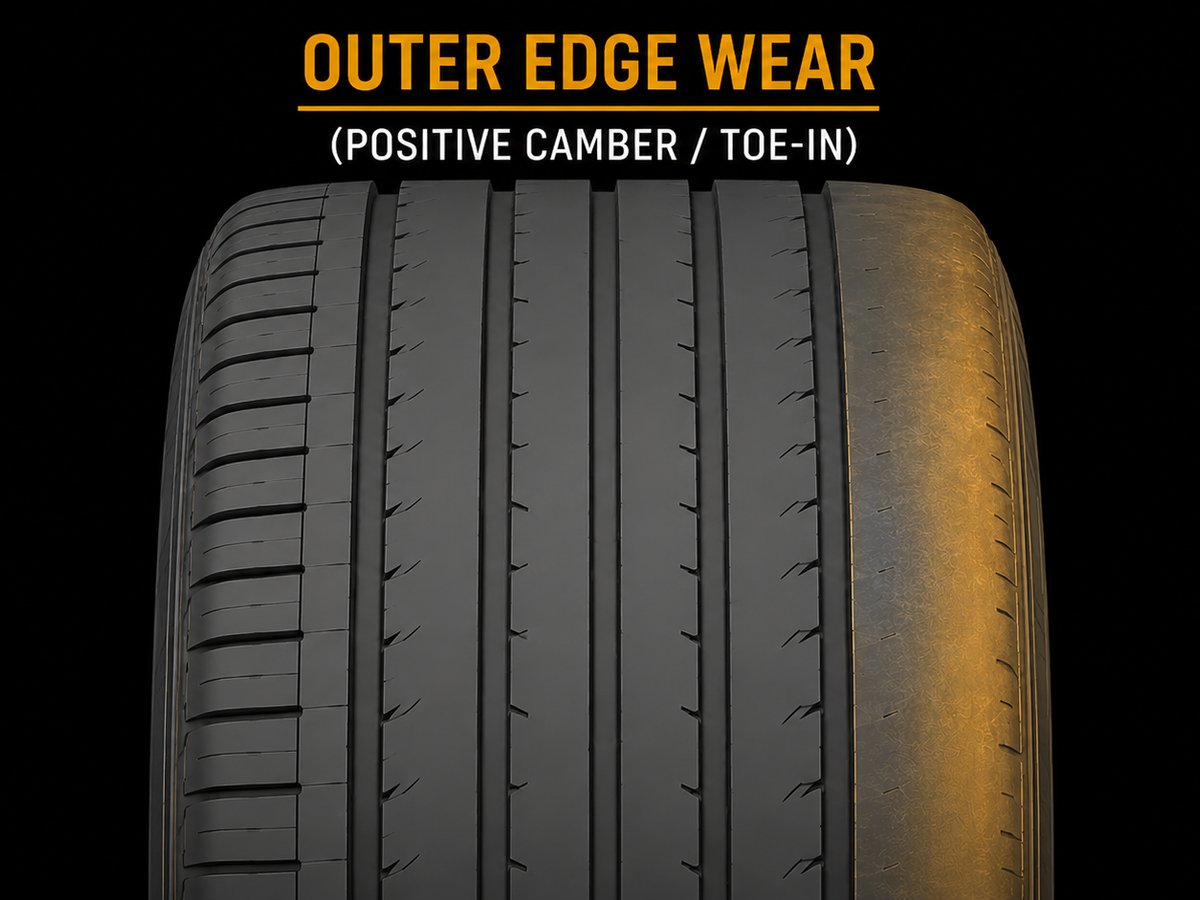
Tire showing outer edge wear

PATTERN 04 · OUTER EDGE WEAR

Alignment

Outside edge gone, inside full

VISUAL SIGNATURE

Outboard edge (facing away from the vehicle) worn down significantly. Inboard edge has nearly full tread depth. Mirror image of inner-edge wear. Often shows on one corner more than the others.

ROOT CAUSE

Excessive positive camber (top of wheel leaning out) or toe-in at that corner. Comes from sagged or weakened springs (vehicle settled), bent strut/spindle, raised vehicle without alignment correction, or sustained heavy loads in trucks/SUVs without re-aligning afterwards.

REPAIR SCOPE

Measure ride height before aligning — sagged springs throw camber out without any other fault. Inspect upper strut bearing and mount. Full alignment with camber and SAI verification. If lift kit was installed, check whether alignment was done after.

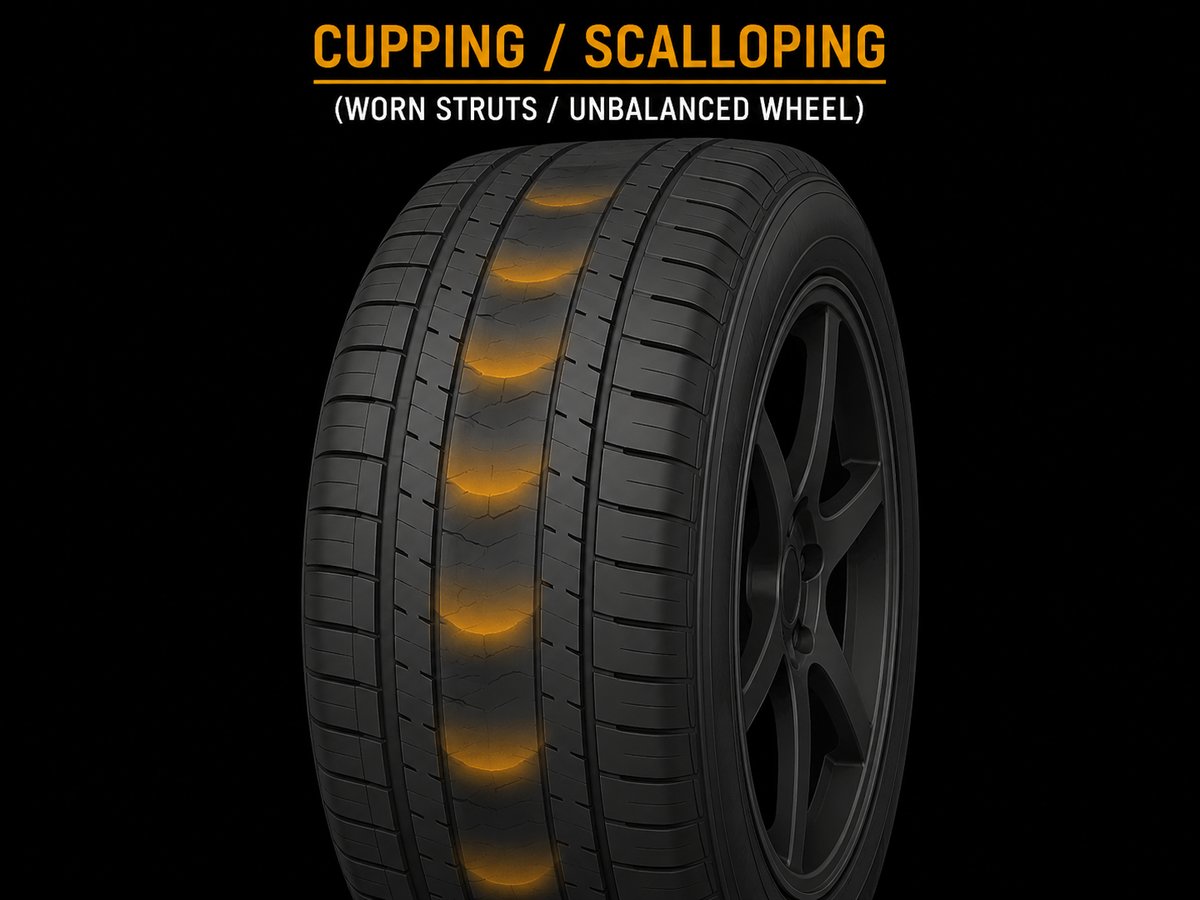
Tire showing cupping pattern

PATTERN 05 · CUPPING / SCALLOPING

Suspension

Repeating bowl-shaped depressions

VISUAL SIGNATURE

Bowl-shaped depressions repeating around the circumference, evenly spaced every few inches. Tire feels rough when run by hand. Often makes a loud humming/droning road noise that customers complain about before they notice the visual pattern. Usually on rears of front-drive cars.

ROOT CAUSE

Suspension component not damping properly — tire bounces in and out of contact with the road. Sources: worn struts/shocks (the most common), severe wheel imbalance, worn upper strut mount bearing, broken or worn strut spring. Less commonly: worn ball joints or tie-rod end allowing wheel to skip.

REPAIR SCOPE

Bounce test all four corners. Replace worn struts/shocks as axle pairs. Replace strut mounts with the struts (always — bearings fail too). Rebalance all four wheels with road-force or Hunter equipment. Cupped tires often need replacement; they won't smooth out.

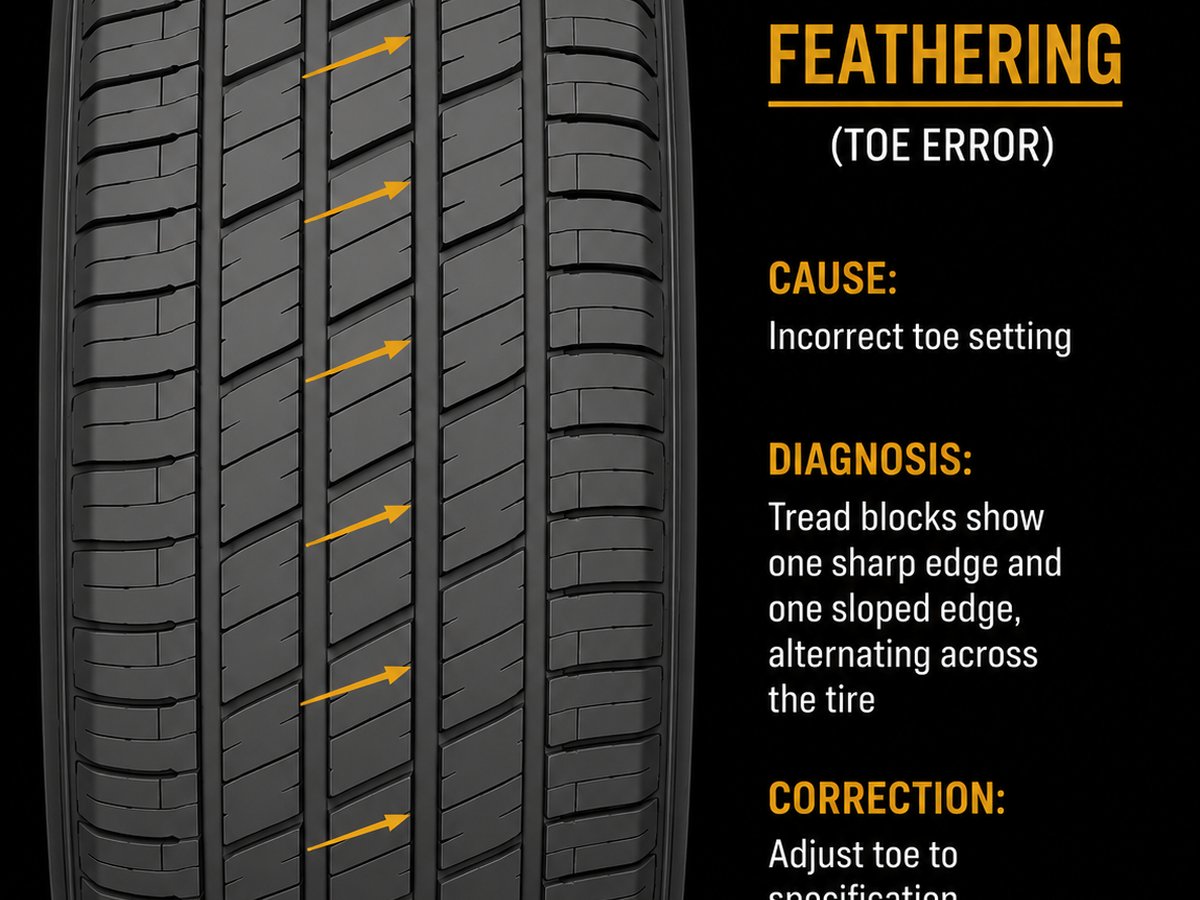
Tire showing feathering pattern

PATTERN 06 · FEATHERING

Alignment

Sharp edge one side, ramp on the other

VISUAL SIGNATURE

Each tread block has one sharp vertical edge and one sloped/ramp-shaped edge, alternating consistently across the tread width. Run your palm across the tread — smooth one way, catches the other way. Both fronts usually show it together.

ROOT CAUSE

Toe alignment is off — wheels are not pointing exactly straight ahead. Tire is being dragged sideways slightly with every revolution, scrubbing material off one edge of each block. Toe-in feathers outboard; toe-out feathers inboard. Even small toe errors (0.10° or less) produce visible feathering over thousands of miles.

REPAIR SCOPE

Full alignment with toe set carefully. Inspect tie-rod ends for play, rack mounts, inner tie-rod sockets. If feathering is severe enough to cause noise (which it often is), the tires may need replacement — the rough surface won't smooth out. Customer gets quoted alignment + possibly tires.

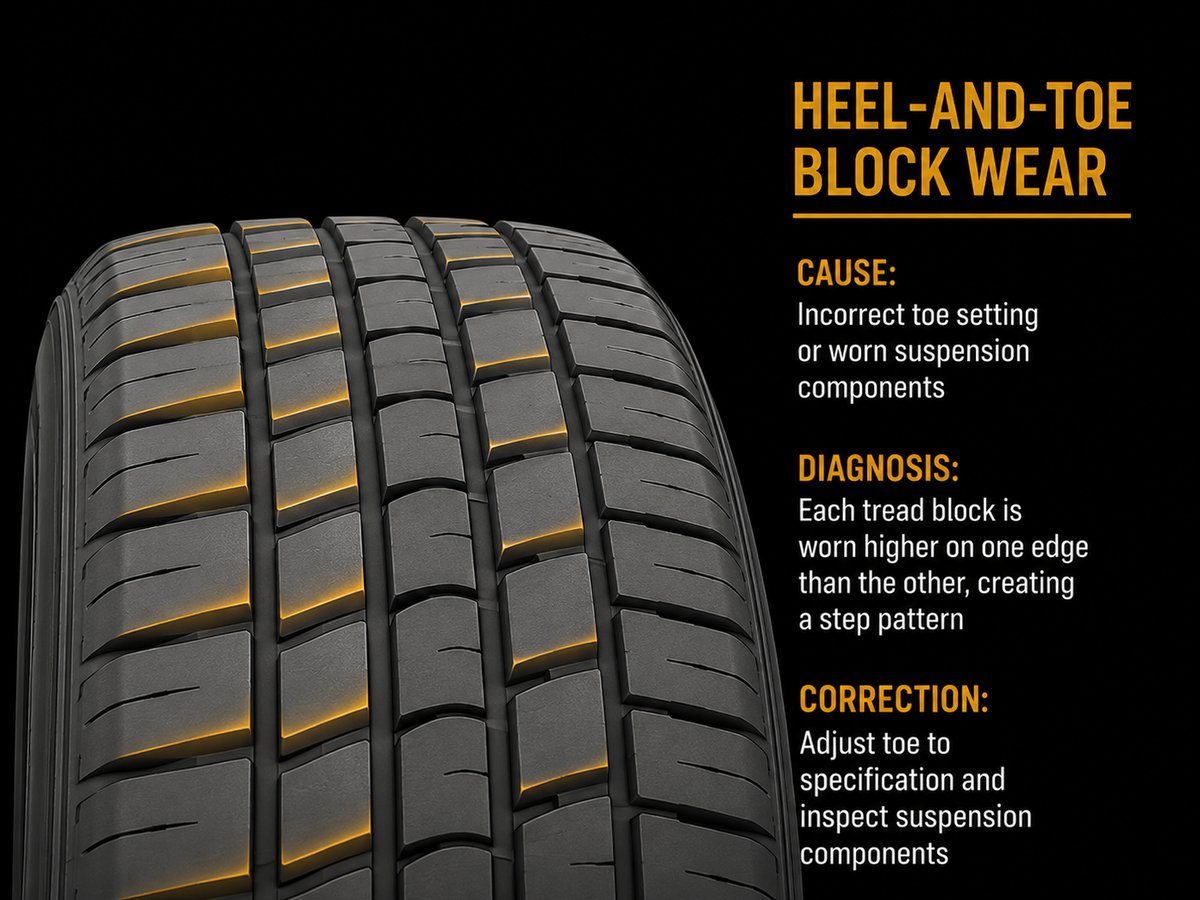
Tire showing heel-and-toe block wear

PATTERN 07 · HEEL-AND-TOE BLOCK WEAR

Suspension

Each block worn higher on one edge

VISUAL SIGNATURE

Each individual tread block is worn higher on one edge than the other, creating a small visible step on each block. Run a hand along the tread — you feel ridges. Common on the rear tires of front-drive vehicles that don't get rotated regularly.

ROOT CAUSE

Caused by the rear tire being a non-driven, non-braking wheel — torque only comes from braking and cornering, applied to one edge of each block at a time. Combined with skipped rotations, blocks wear into a heel-and-toe step. Also caused by light rear toe-in/out, slightly worn rear shocks, or rear suspension bushing wear.

REPAIR SCOPE

Rotate tires (criss-cross or rearward depending on tire type) every 5,000–7,500 miles to prevent. Inspect rear suspension bushings and shocks. If pattern is severe and noisy, tires need replacement; new tires with good rotation discipline last 30–40% longer. Most common preventive maintenance miss in the bay.

TRAPS TECHS FALL INTO
1
SELLING ALIGNMENT WITHOUT FIXING PARTS FIRST

Worn ball joints, sagged springs, and torn bushings change the alignment angles dynamically. Setting alignment to spec on bad parts gets a passing printout that's wrong as soon as the vehicle hits the road. Always inspect and replace worn suspension parts first, then align. Otherwise the customer comes back in 3,000 miles with the same wear pattern.

2
IGNORING THE REAR AXLE

Front-end pull is often the rear axle dog-tracking. Heel-and-toe rear wear without rotation discipline is the most missed pattern in the bay. Always inspect all four tires, even on a front-end complaint, and always set rear thrust angle if your alignment system can.

3
CONFUSING CUPPING WITH BALANCE

Cupping looks like a balance problem and a customer might say "the tires need balancing." Balance won't fix it. Cupping is suspension — worn struts or strut mounts. Diagnose with a bounce test and a road test, not just by looking at the tire. Quote shocks/struts, not balance, when cupping is present.

4
SKIPPING THE BOTH-SIDES COMPARISON

Wear pattern on only one tire = isolate to that corner (bent part, single-wheel alignment issue). Same pattern on both tires of an axle = inflation or alignment. Same pattern on all four = customer habits or chronic maintenance miss. Always look at all four before diagnosing. Two minutes saves two hours of wrong-direction diagnosis.

QUICK REFERENCE · ONE-PAGE SUMMARY

Print this. Stick it inside your toolbox lid.

PatternSystemMost-likely cause
Center band wornTireOverinflation
Both shoulders wornTireUnderinflation · slow leak
Inner edge onlyAlignmentNegative camber · toe-out · worn ball joint · sagged spring
Outer edge onlyAlignmentPositive camber · toe-in · sagged spring · raised vehicle
Cupping / scallopingSuspensionWorn struts · strut mount · severe imbalance
FeatheringAlignmentToe error · inner tie-rod wear
Heel-and-toe blocksSuspensionSkipped rotations · rear shock wear · bushings

Diagnose order: inspect all four → bounce test → measure pressure cold → ride height → ball joints + bushings → alignment last.